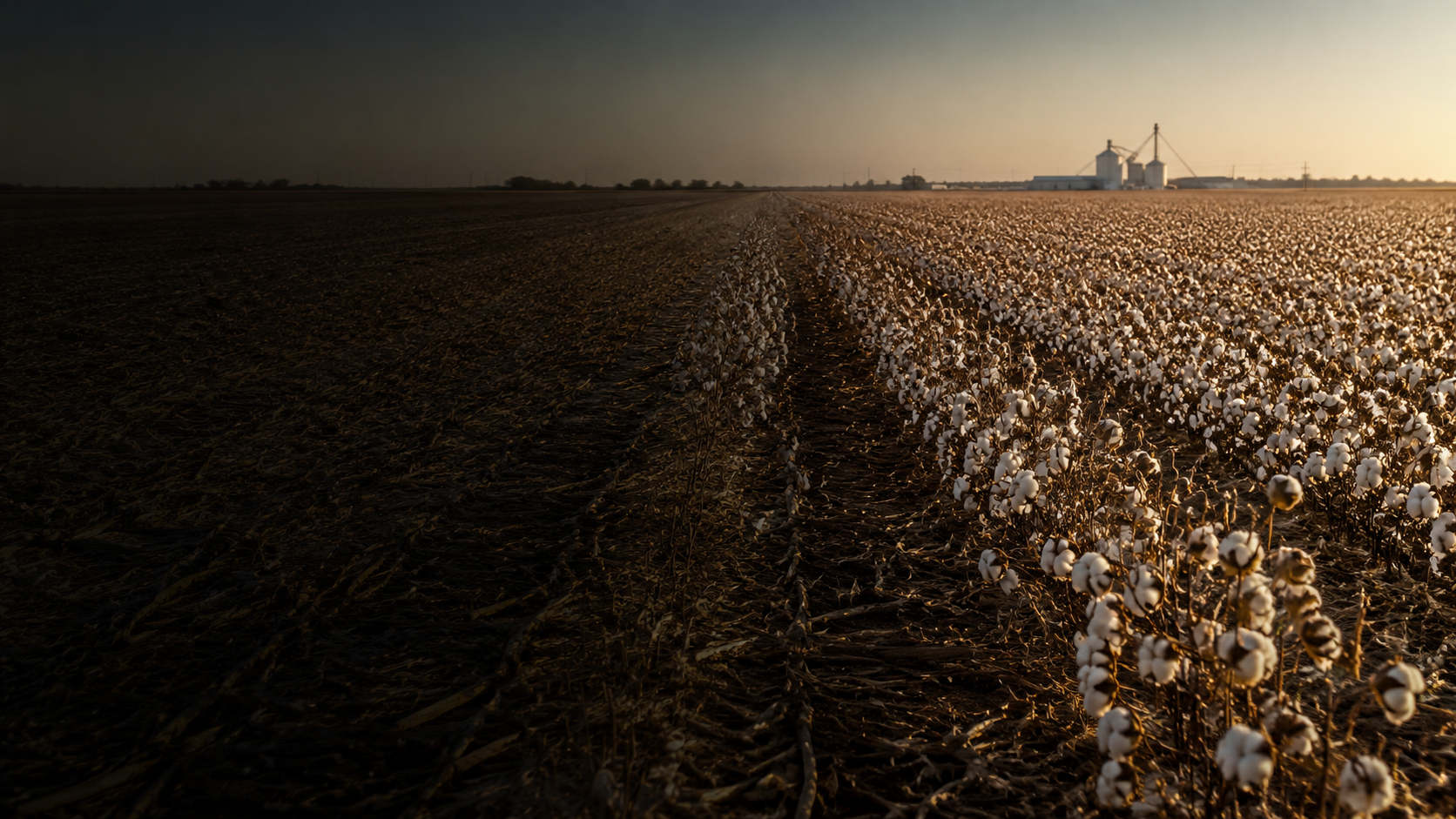
Existing crop
Preserve the farmer’s primary crop value and work with the biology already being produced.
The missing link
SERAT is the bridge between a variable biological feedstock and repeatable industrial material.
From maximizing yield per acre to optimizing total value per acre.
The value shift
Take cotton. The farmer should keep maximizing cotton yield and selling lint through the existing value chain. SERAT does not aim to disrupt what already works.
But lint is only one part of the biology produced by that acre. Stalks and remaining biomass contain fiber and other potentially valuable material fractions.
Agriculture → advanced materials
Agriculture has spent generations maximizing yield per acre. SERAT is being developed for the next shift: optimizing the total value created by every acre.
Preserve the farmer’s primary crop value and work with the biology already being produced.
Aggregate stalks and other suitable biomass through a practical regional model.
Use SERAT’s developing electrochemical process to separate biomass into usable material fractions.
Standardize outputs for qualification in textiles, composites, construction, packaging and beyond.
Beyond a single crop
If industry needs cottonized natural fiber, cotton may not always be the best starting material. Under the right local conditions, hemp—or another crop—may create greater total fiber and total value per acre.
The question changes from “How much of one crop?” to “What combination of biology and materials creates the most value here?”
The infrastructure layer
The American farmer does not need to invent the fields. America needs the infrastructure that translates regional crops into reliable industrial feedstock.
The American farmer should not be the lowest-value point in the agricultural-industrial value chain.
Method before scale
SERAT is a development-stage platform. The path forward is intentionally sequenced around material proof and market qualification.